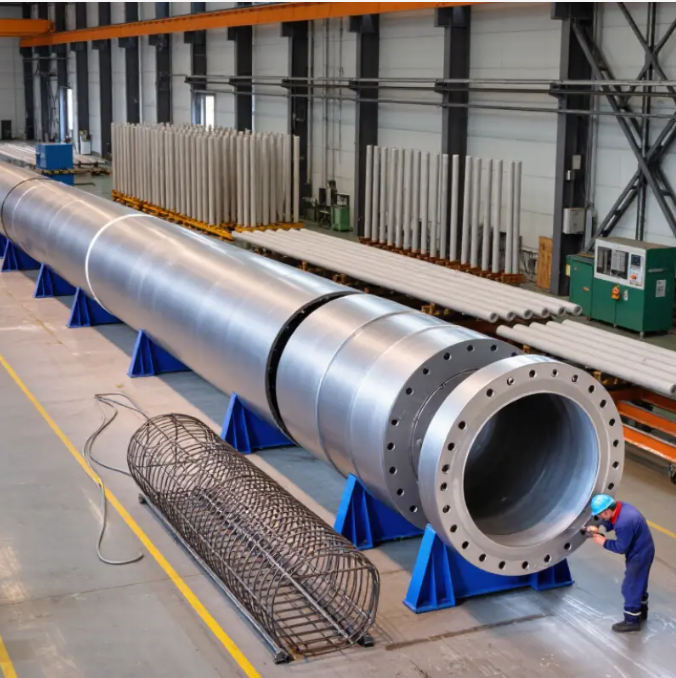
LINYI, SHANDONG, CHINA, November 19, 2026 /EINPresswire.com/ — A Concrete Pole Mould is the unsung hero behind reinforced concrete utility poles, giving wet concrete its shape, size, and smooth finish. When poles need to meet strict structural standards, the mould keeps everything consistent—preventing variations that could compromise safety and durability.
As concrete-forming specialist Michael R. Turner of FormTech Industrial Solutions notes, a good mould isn’t just about shaping concrete; it’s about controlling repeatability, alignment, and early-stage strength. Steel moulds are often the go-to for their rigidity and longevity, while fiberglass and polymer ones are lighter and easier to handle. Every material has its own quirks and limitations.
Here’s how the process works. First, clean and inspect the mould, then apply a release agent so the concrete doesn’t stick. Next, set up the reinforcement cages and any embedded parts, then pour the concrete in controlled layers rather than dumping it all at once. Vibration removes air pockets and helps the mix flow into tight spots—too little causes honeycombing, while too much can separate the mix.
After curing, the team opens the mould, lifts out the pole, and checks dimensions, cracks, surface voids, and reinforcement placement. Small defects are easy to miss, which is where production-line discipline counts.
There’s no one-size-fits-all concrete pole mould; you have to match it to your mix, curing process, pole design, and daily factory operations. Over time, temperature swings, repeated heavy loads, and slight misalignments can chip away at performance, making mould upkeep essential. Next, we’ll cover mould components, step-by-step use, materials, and common real-world issues—because the devil’s in the details.
Definition and Purpose of a Concrete Pole Mould
A concrete pole mould is a reusable form that shapes fresh concrete into a strong, consistent pole. Its main purpose is dimensional control. It keeps the pole’s diameter, length, and surface profile stable during production. A Concrete Pole Steel Mould usually contains rigid steel sections, alignment parts, and fastening devices. Steel resists pressure from wet concrete and supports repeated use.
During operation, workers clean the mould and apply a suitable release agent. They then position reinforcement and pour the concrete mixture inside. Vibration removes trapped air and helps the concrete fill narrow spaces around the reinforcement. The closed mould holds the pole while the concrete gains enough strength for demoulding. Fit matters. Even a small gap can create fins, leakage, or uneven edges.
Practical inspection should include mould alignment, wall thickness, bolt condition, and surface wear. Experienced operators also check whether the finished pole bends, cracks, or shows exposed reinforcement. These details reveal problems that measurements alone may miss. Curing conditions remain important after removal. Poor moisture control can weaken an otherwise well-shaped pole. The process is not perfectly forgiving. A clean mould may still produce defects if the concrete mix, vibration, or reinforcement placement is inconsistent. That is why production records and regular maintenance support reliable results.
What Is a Concrete Pole Mould and How Does It Work? — Definition and Purpose
Dimension Definition Purpose and Working Principle Key Technical Considerations
Basic Definition A concrete pole mould is a reusable or single-use form that gives fresh concrete the required shape and dimensions while it hardens. It contains the concrete mixture, supports embedded reinforcement, and produces a consistent pole profile. The mould must resist pressure from fresh concrete without excessive deformation or leakage.
Main Function The mould acts as a temporary external boundary around the concrete pole during casting and curing. It transfers the intended design geometry to the finished pole, including length, diameter, taper, holes, and surface features. Accurate mould dimensions help maintain interchangeability and consistent installation performance.
Typical Mould Materials Common materials include steel, aluminum, fiberglass-reinforced polymer, plastic, wood, and other engineered composite materials. Material selection affects mould strength, weight, durability, surface finish, thermal behavior, and reuse potential. Rigid moulds are generally preferred for repeated production because they maintain dimensional accuracy.
Pole Cross-Section Concrete pole moulds may be designed for circular, octagonal, square, rectangular, tapered, or other specified cross-sections. The cross-section determines how the pole distributes bending, compression, and handling forces. The selected shape should match the structural design and the intended utility or construction application.
Reinforcement Positioning Reinforcing bars, prestressing wires, or other reinforcement are placed inside the mould before concrete placement. The mould and its spacers help maintain the required reinforcement alignment and concrete cover. Correct cover is important for protecting reinforcement from moisture, carbonation, and corrosion.
Concrete Placement Fresh concrete is introduced into the assembled mould around the reinforcement cage or prestressing system. Controlled filling reduces voids and ensures that concrete surrounds the reinforcement throughout the pole. Placement rate, mixture workability, and vibration or compaction method influence the final density and finish.
Compaction Compaction removes trapped air and helps concrete flow into corners, around reinforcement, and along the mould wall. It improves consolidation, surface quality, and the continuity of the hardened concrete. Insufficient compaction can cause honeycombing, while excessive vibration may contribute to segregation.
Curing Process After casting, the concrete remains in controlled conditions so hydration can develop strength and reduce early defects. Curing supports the required mechanical properties and dimensional stability before demoulding or service use. Moisture, temperature, curing duration, and the concrete mixture all affect strength development.
Demoulding Demoulding is the controlled removal of the form after the concrete has reached sufficient handling strength. It releases the hardened pole without damaging edges, inserts, surfaces, or reinforcement cover. Release agents and properly designed joints can reduce sticking and simplify mould removal.
Surface Finish The inside surface of the mould transfers its texture and smoothness to the exterior of the concrete pole. A well-maintained mould can produce a uniform surface that improves appearance and helps limit surface irregularities. Cleanliness, joint alignment, release-agent application, and mould wear directly affect finish quality.
Dimensional Control Dimensional control covers the pole length, outside dimensions, taper, straightness, openings, and insert locations. Consistent dimensions allow poles to meet design requirements and fit compatible hardware or foundations. Measurements should be checked routinely because wear, thermal movement, and improper assembly can affect accuracy.
Structural Performance The mould does not provide the pole’s permanent structural capacity; that capacity comes mainly from the hardened concrete and reinforcement. The mould ensures that the structural section is formed correctly so the designed load-bearing properties can be achieved. Final performance depends on concrete strength, reinforcement, geometry, curing, loads, and applicable design standards.
Reusability Reusable moulds are designed for repeated casting, while disposable moulds are removed or discarded after limited use. Reusability can improve production efficiency and consistency when the mould is properly cleaned and maintained. Service life depends on material durability, handling practices, joint condition, and exposure to abrasion or corrosion.
Quality Inspection Inspection commonly covers mould alignment, dimensions, cleanliness, reinforcement placement, concrete consolidation, and finished-pole defects. Routine inspection helps identify problems before they affect multiple poles in a production cycle. Typical defects include cracks, voids, honeycombing, surface blemishes, dimensional deviations, and exposed reinforcement.
Primary Applications Concrete pole moulds are used to manufacture poles for electrical distribution, lighting, communications, fencing, and other infrastructure systems. They enable repeatable production of poles designed for vertical support, cable routing, equipment mounting, or boundary systems. The mould configuration should be selected according to the pole’s intended loads, accessories, and installation environment.
Main Components and Structural Design
What Is a Concrete Pole Mould and How Does It Work?
Main Components and Structural Design
A concrete pole mould is a temporary structural shell that shapes wet concrete into a consistent pole. Its main components include a steel mould body, end plates, locking clamps, and internal support features. The mould body may be cylindrical, tapered, or polygonal, with tapered cavities common for saving material while keeping strength. End plates control pole length and alignment during casting.
Inside, a reinforcement cage supports cured concrete, while spacers keep steel bars off the mould wall for proper cover. Clamps must resist concrete pressure and vibration so weak locking points do not cause leakage, bulging, or uneven surfaces. Vibration moves concrete into narrow spaces around reinforcement and removes trapped air. Slight alignment offsets can affect appearance and load performance.
Tips: Check the shell for dents, rust, and distorted edges before use, and confirm clamps close evenly. Apply a thin, uniform release agent—too much can stain concrete. Check spacer positions carefully, especially near joints, and remember drainage and cleaning access. A practical design balances stiffness, easy demoulding, safe handling, and repeatable dimensions through brief checks each cycle.
Materials Used in Concrete Pole Mould Manufacturing
A concrete pole mould is a rigid metal form used in casting and centrifugal spinning, where material choice affects accuracy, service life, and maintenance cost. Most industrial moulds use fabricated carbon steel for vibration and clamping resistance: ASTM A36 offers about 250 MPa minimum yield strength, and S355 under EN 10025 offers about 355 MPa.
Steel thickness must suit pole diameter, concrete pressure, and spinning speed—thin plates may deform near flanges, while excess thickness adds weight and handling difficulty. Internal surfaces are typically machined or ground and coated for release; poor preparation causes fins, stains, and demoulding marks.
With 2023 crude steel production around 1.89 billion tonnes (World Steel Association, 2024) and cement linked to roughly 7% of global CO2 emissions (Global Cement and Concrete Association), manufacturers favor reusable shells, repairable flanges, and longer service intervals. Stainless steel resists corrosion better but is often too costly. Field checks often catch uneven bolts, worn edges, or missed drainage points that alter dimensions.
How a Concrete Pole Mould Works Step by Step
A concrete pole mould is a reusable steel or composite form that shapes fresh concrete while resisting pressure, vibration, and repeated opening. A Concrete Fencing Pole Mould also requires accurate dimensions for proper installation alignment.
First, clean the mould and apply a thin release agent, then place the centered reinforcement cage, spacers, and lifting fittings so concrete cover stays even and durable.
Next, pour workable concrete into the closed mould and use vibration to remove trapped air and fill corners; some lines spin the mould to form a denser pole via centrifugal force.
Leave the pole in the mould until it gains early strength, monitoring temperature and moisture so rapid drying does not crack the surface. After demoulding, inspect straightness, dimensions, honeycombing, and reinforcement placement, following engineering standards for repairs or rejections.
With over 14 billion cubic metres of concrete used annually (Global Cement and Concrete Association) and cement accounting for about 7% of global CO2 emissions (IEA), mould accuracy cuts waste across concrete, energy, and transport. Despite the simple workflow, human handling often remains the weak link.
Concrete Pouring, Compaction, and Curing Process
A Concrete Electric Pole Mould is a shaped steel form defining pole diameter, taper, and finish. Before pouring, technicians clean it, apply release agent, and position the reinforcement cage with proper cover, as small gaps cause trouble.
Concrete is poured in controlled layers and guided around reinforcement while internal vibration removes air and improves surface contact. Excessive vibration can separate aggregate from cement paste, so timing needs judgment—expect a steady hum and fading surface bubbles.
During early curing, the closed mould keeps moisture and temperature stable using water, wet coverings, or a controlled enclosure as hydration builds strength. After demoulding, inspectors check for exposed steel, honeycombing, cracks, and dimensional variation. Rushed curing is a common mistake that can leave weak internal zones even on smooth poles. Batch records, vibration time, curing logs, and test results support quality decisions.
Mould Removal, Quality Inspection, and Maintenance
Mould removal starts only after concrete reaches stripping strength, guided by design, cement system, temperature, project specs, and ASTM C31/C31M specimen curing. Workers loosen clamps evenly, lift vertically, and avoid hitting edges to prevent hidden cracks.
Inspection follows a written checklist covering length, diameter, straightness, surface defects, cover, bolt holes, and fittings before dispatch, alongside ACI 347R formwork control and ASTM C39/C39M strength records. Lighting can still hide shallow honeycombing near the base.
Maintenance preserves accuracy over repeated runs: clean hardened concrete with non-damaging tools, clear release-agent residue from joints and drains, store moulds level away from standing water, and log dents, weld fatigue, and dimensional shifts. Per the GCCA 2050 Industry Roadmap, concrete accounts for roughly 7–8% of global CO₂ emissions, so longer mould life cuts replacement materials and waste—yet cleaning is often rushed for speed.
Common Applications and Selection Considerations
A reusable pole mould—typically steel or reinforced composite with clamps, end plates, and release surfaces—shapes concrete around reinforcement using vibration or centrifugal spinning for hollow poles, controlling diameter, length, wall thickness, and texture.
Applications include power lines, street lighting, telecom, rail signals, and fencing. Distribution poles may need strong lifting points and accurate hardware holes, lighting poles often need a cleaner finish and internal cable path, and coastal sites require careful cover and durability; minor errors can show after installation.
Select based on dimensions, concrete pressure, casting method, curing temperature, and reuse cycles rather than looks alone. Heavy steel handles high-volume runs with lifting gear and rust care; composites move easier but vary in stiffness with temperature. Check joints, clamps, drains, and coatings before each batch—smoothness alone won’t prevent cracks from poor vibration or weak reinforcement, and rushing to cheap moulds warrants caution where tolerances and safety matter.
QT6-15 Fully Automatic Hydraulic Concrete Cement Block Brick Making Machinery: Market Insights from Grand View Research Reports
QT6-15 fully automatic hydraulic concrete block brick making machinery meets demand for high-output, consistent, resource-efficient production as urban and infrastructure growth drives automation, lower labor, and steady quality. Using automated forming and hydraulic pressure, it runs continuously and integrates with conveyors, two-bin batchers, stacker cranes, and mixers to cut cycle times and scale output.
It flexibly processes cement, sand, gravel, fly ash, slag, and recycled construction waste based on local availability and product needs. Swapping molds produces standard bricks, hollow blocks, porous bricks, pavers, slope bricks, and more for residential, commercial, municipal, and landscaping uses while supporting sustainable reuse of by-products and recycled aggregates.
Conclusion
A Concrete Pole Mould is a specially designed forming system used to manufacture strong, uniform concrete poles for electrical, communication, lighting, and infrastructure projects. Its main purpose is to shape fresh concrete accurately while maintaining consistent dimensions and surface quality. The mould typically includes a rigid body, end plates, locking components, reinforcement supports, and openings or fittings that help position internal steel or prestressing elements. Manufacturers may use durable steel or other suitable materials selected for strength, dimensional stability, and resistance to repeated production cycles.
The process begins with assembling and preparing the mould, placing reinforcement, and applying a suitable release treatment. Concrete is then poured into the mould and compacted to remove air pockets and improve density. After controlled curing, the hardened pole is carefully removed and inspected for dimensions, cracks, strength, and surface defects. Regular cleaning, lubrication, alignment checks, and repairs help extend mould service life. When selecting a Concrete Pole Mould, users should consider pole size, production capacity, concrete technology, handling requirements, maintenance needs, and the required quality standards.
Shandong Shunya Machinery Co., Ltd.
Shandong Shunya Machinery Co., Ltd.
Legal Disclaimer:
EIN Presswire provides this news content “as is” without warranty of any kind. We do not accept any responsibility or liability
for the accuracy, content, images, videos, licenses, completeness, legality, or reliability of the information contained in this
article. If you have any complaints or copyright issues related to this article, kindly contact the author above.

Media gallery