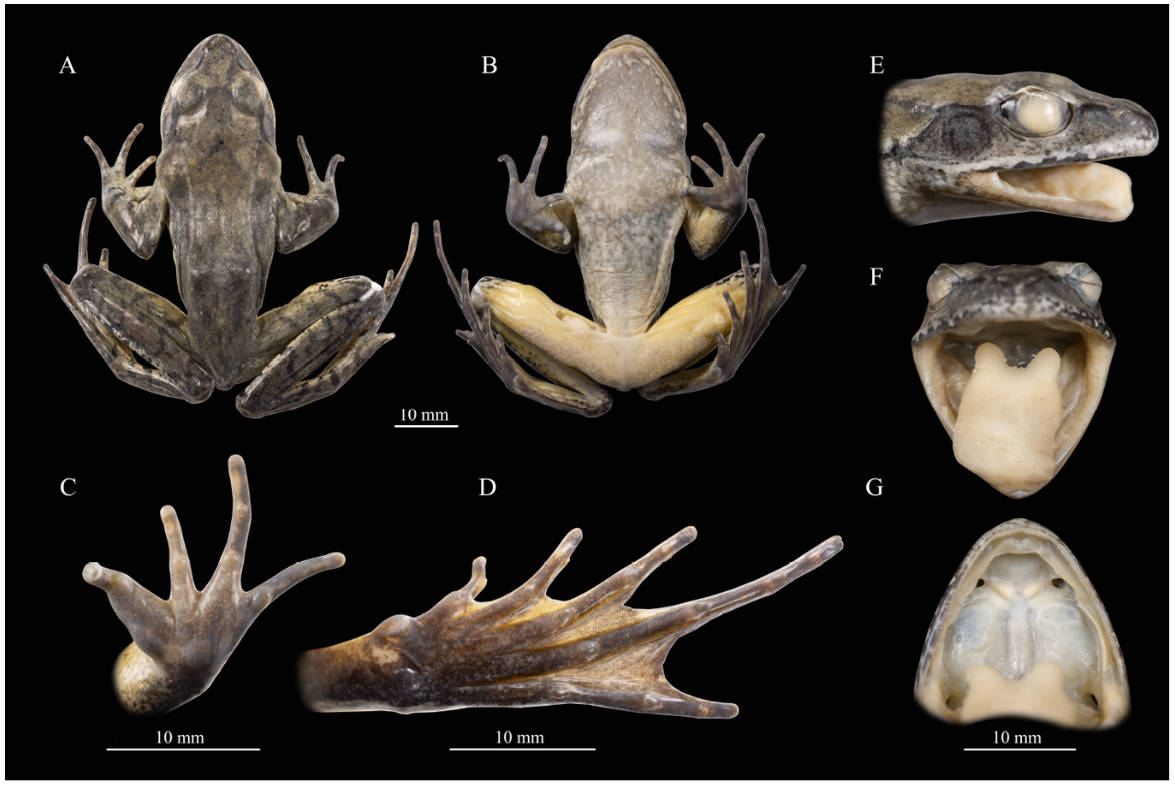
GA, UNITED STATES, October 27, 2026 /EINPresswire.com/ — Researchers have described Rana shii sp. nov., a medium-sized brown frog from Chongqing, China, that forms an independent evolutionary lineage and is the sister species of Rana maershanensis. The species is distinguished by a combination of features, including the absence of a vocal sac, well-developed dorsolateral folds that are straight or slightly curved outward at the temporal region and do not connect to the posterior corner of the eye, toe tips without lateroventral grooves, and hindlimbs that bring the tibiotarsal articulation to or beyond the snout tip when stretched. Field observations indicate that it breeds in ponds in early April. The discovery expands the known range of this unassigned Rana lineage into southwestern China and highlights overlooked brown-frog diversity.
Chinese Rana species are often divided into four species groups, yet several species remain unassigned, including Rana maershanensis. Previous studies recovered R. maershanensis as a distinct lineage outside these groups, but its relationships with other Rana species have remained unstable and weakly supported. Some analyses placed it near the Rana japonica group, whereas later genomic work did not recover that grouping. Morphological comparisons have also been limited by incomplete sampling across unassigned lineages. This gap limits both diagnosis and conservation assessment. Given these challenges, further research is needed on the phylogenetic placement and cryptic diversity of the R. maershanensis lineage.
Researchers from the School of Life Sciences and the Key Laboratory of Freshwater Fish Reproduction and Development (Ministry of Education), Southwest University, with colleagues from Slippery Rock University and the Chongqing Yintiaoling National Nature Reserve Administration Center, published (DOI: 10.3724/ahr.2095-0357.2026.0016) the findings in Asian Herpetological Research on 04 June 2026. The team collected eight adult Rana specimens and an egg clutch during 2025 surveys in Chongqing Yintiaoling National Nature Reserve and Hongchiba National Forest Park, Wuxi County, and used morphological and molecular evidence to describe the new species.
The new species was recovered as an independent clade (Bayesian posterior probability [BPP] = 1; bootstrap support [BS] = 100) sister to R. maershanensis (BPP = 0.98; BS = 96), outside the four recognized Chinese Rana groups. Mean genetic distances between R. shii and R. maershanensis were 7.51% for the mitochondrial cytochrome c oxidase subunit I (COI) gene and 2.29% for the 16S ribosomal RNA (16S rRNA) gene; mean intraspecific distances were 0.78% and 0.3%, respectively. Morphologically, the species has a medium body size (male snout-vent length [SVL] 52.7–58.3 mm; female SVL 54.8–62.2 mm), no vocal sac, a tympanum slightly larger than half the eye diameter, vomerine teeth in two oblique rows between the choanae, a deeply notched tongue, and nuptial pads divided into two patches without nuptial spines. Toe length order is IV > V > III > II > I, and males lack abdominal lineae masculinae. The holotype, an adult male (SWU 0015390), was collected at 2,265 m in Chongqing Yintiaoling National Nature Reserve. Field observations recorded breeding in ponds in early April, with black animal-pole and grayish-white vegetal-pole eggs.
The authors said the discovery is less about a single frog than about what remains unseen. They said the new species and R. maershanensis form a two-species clade whose wider relationships still need stronger genomic sampling, especially nuclear genes. They described the Chongqing population as geographically distant from R. maershanensis in central-southern China, consistent with allopatric speciation, and said the finding signals that additional cryptic diversity may still be hidden in this lineage. They said future surveys should target montane wetlands and integrate morphology, calls, and multilocus data.
The finding adds a newly documented amphibian to the fauna of Chongqing and extends the known distribution of the R. maershanensis lineage into southwestern China. Because the new species breeds in montane wetland ponds and shares habitat with R. chensinensis, targeted monitoring can inform reserve management, habitat protection, and amphibian surveys in the Daba Mountains. The authors emphasize that resolving the lineage’s placement will require broader taxonomic sampling and nuclear markers. Such work can sharpen biodiversity baselines, guide conservation prioritization, and improve detection of cryptic frog species in poorly surveyed montane wetlands.
References
DOI
10.3724/ahr.2095-0357.2026.0016
Original Source URL
https://doi.org/10.3724/ahr.2095-0357.2026.0016
Funding information
National Natural Science Foundation of China (NSFC) grants 32170478, 32370478, and 32470458; Youth Top Talent Program of Chongqing (CQYC20220510893); and the Special Survey Project on Amphibian and Reptile Resources of the Chongqing Yintiaoling National Nature Reserve.
Lucy Wang
BioDesign Research
Legal Disclaimer:
EIN Presswire provides this news content “as is” without warranty of any kind. We do not accept any responsibility or liability
for the accuracy, content, images, videos, licenses, completeness, legality, or reliability of the information contained in this
article. If you have any complaints or copyright issues related to this article, kindly contact the author above.

Media gallery