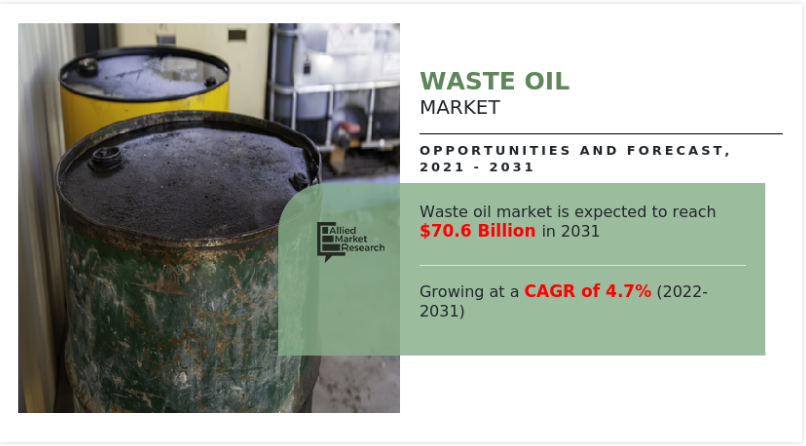
Waste oil market is projected to reach $70.6 billion by 2031, driven by recycling technologies and industrial growth.
WILMINGTON, DE, UNITED STATES, June 4, 2026 /EINPresswire.com/ —
According to a recent report published by Allied Market Research, the global waste oil market size was valued at $45.0 billion in 2021 and is projected to reach $70.6 billion by 2031, growing at a CAGR of 4.7% from 2022 to 2031.
The increasing focus on sustainable resource management, environmental protection, and circular economy practices is transforming the global waste oil industry. Waste oil, once considered a disposal challenge, has evolved into a valuable secondary resource that can be collected, processed, recycled, and reused across multiple industrial sectors. Rising industrialization, expanding transportation networks, increasing vehicle ownership, and growing investments in waste management infrastructure are expected to support steady market growth throughout the forecast period.
Download PDF Brochure: https://www.alliedmarketresearch.com/request-sample/17349
As governments worldwide implement stricter environmental regulations and industries seek cost-effective alternatives to virgin petroleum products, the demand for advanced waste oil recovery and recycling technologies continues to increase. These developments are positioning the waste oil market as an important component of global sustainability initiatives.
Understanding Waste Oil and Its Importance
Waste oil refers to any petroleum-based or synthetic oil that has become contaminated and is no longer suitable for its original purpose. During operation, oils accumulate impurities such as dirt, metal particles, water, chemicals, and combustion byproducts that reduce their effectiveness and performance.
Common forms of waste oil include used engine oil, transmission oil, hydraulic fluids, lubricating oils, compressor oils, and industrial process oils. Once these oils reach the end of their useful life, they must either be recycled, re-refined, or disposed of through environmentally responsible methods.
Rather than treating waste oil as a hazardous byproduct, many industries now recognize it as a valuable resource. Through advanced recycling and re-refining processes, used oil can be transformed into high-quality base oils, industrial fuels, and lubricants. This not only conserves natural resources but also reduces environmental pollution and minimizes dependence on crude oil extraction.
The growing awareness of sustainable waste management practices has significantly increased the importance of waste oil recovery systems worldwide.
Key Factors Driving Waste Oil Market Growth
Several economic and industrial factors are contributing to the expansion of the waste oil market.
Rapid industrialization remains one of the most important growth drivers. Manufacturing facilities, mining operations, construction companies, transportation fleets, and energy production plants consume substantial volumes of lubricants and industrial oils. As industrial activity increases globally, larger quantities of waste oil are generated, creating opportunities for recycling and reprocessing businesses.
Urbanization is another major contributor. Expanding cities require extensive transportation networks, construction projects, utility infrastructure, and industrial facilities, all of which rely heavily on lubricants and machinery oils. The growing concentration of economic activities in urban centers continues to increase waste oil generation.
Rising disposable income levels in developing countries have also boosted vehicle ownership. More passenger cars, commercial vehicles, and industrial equipment translate directly into higher consumption of engine oils and lubricants, which eventually enter the waste oil collection and recycling stream.
Government investments in transportation infrastructure and road connectivity projects further contribute to market growth by increasing the use of heavy machinery, trucks, and construction equipment that require regular lubrication and maintenance.
Growing Adoption Across End-Use Industries
The utilization of waste oil is expanding across numerous industries due to its economic and environmental benefits.
The automotive sector remains one of the largest contributors to waste oil generation. Every vehicle requires periodic oil changes to maintain engine performance and efficiency. With millions of vehicles operating worldwide, the volume of used engine oil generated annually continues to increase significantly.
The energy and power sector also relies heavily on lubricants for turbines, generators, transformers, and other critical equipment. Proper collection and recycling of used oils help operators reduce maintenance costs while supporting sustainability objectives.
Manufacturing industries generate substantial quantities of waste oil through machining operations, hydraulic systems, compressors, and production equipment. Many industrial facilities are adopting waste oil recycling programs to improve operational efficiency and comply with environmental regulations.
Marine, mining, construction, and aviation sectors are also important consumers of industrial lubricants, contributing to the growing availability of recyclable waste oil streams.
Role of Recycling and Re-Refining Technologies
Technological advancements in waste oil processing have significantly improved the value proposition of waste oil recycling.
Modern recycling systems can remove contaminants, restore oil quality, and produce base oils that meet stringent performance standards. Re-refining processes allow used lubricants to be converted into products that can compete with virgin oils in terms of quality and performance.
Re-refining is increasingly recognized as one of the most environmentally sustainable approaches to waste oil management. The process requires less energy compared to producing lubricants from crude oil and substantially reduces greenhouse gas emissions.
Advanced treatment technologies such as vacuum distillation, thin-film evaporation, and hydrogen treatment are helping companies maximize recovery rates while improving product quality. As these technologies continue to evolve, the economic viability of waste oil recycling operations is expected to improve further.
The growing adoption of circular economy principles by governments and industries is creating additional momentum for re-refining investments worldwide.
Procure This Report (275 Pages PDF with Insights, Charts, Tables, and Figures): https://www.alliedmarketresearch.com/waste-oil-market/purchase-options
Environmental Benefits Supporting Market Expansion
Environmental sustainability has become a central theme in the waste oil market.
Improper disposal of used oil can contaminate soil, groundwater, rivers, and ecosystems. Even small quantities of waste oil can cause significant environmental damage if released into the environment. Consequently, governments have implemented strict regulations governing the collection, transportation, storage, and disposal of waste oils.
Recycling waste oil helps reduce environmental risks while conserving valuable natural resources. Every gallon of recycled oil reduces the need for crude oil extraction and refining activities, lowering overall environmental impact.
In addition, waste oil recycling contributes to carbon reduction goals by decreasing energy consumption and greenhouse gas emissions associated with lubricant production. These sustainability benefits are encouraging businesses and governments to invest in modern waste oil management infrastructure.
As environmental awareness continues to increase among consumers and industries, demand for responsible waste oil solutions is expected to strengthen over the coming years.
Market Segmentation Analysis
The waste oil market is segmented by type, application, technology, and region.
Based on type, the market includes transmission oil, engine oil, and lubricants. Among these segments, lubricants accounted for the largest market share in 2021, representing approximately 56% of total market revenue. The segment is also expected to record the highest growth rate through 2031 due to increasing industrial lubricant consumption across multiple sectors.
From an application perspective, the market is divided into waste oil boilers and re-refiners. Re-refining has emerged as one of the most attractive application areas because it enables the production of high-quality base oils from used lubricants. Growing investments in circular economy initiatives are expected to support strong demand for re-refining services throughout the forecast period.
By technology, the market includes vacuum distillation processes, distillation hydrogen treatment, and thin-film evaporation systems. Vacuum distillation remains one of the most widely adopted technologies due to its efficiency, scalability, and ability to produce high-quality recovered oil products.
Regional Insights
Asia-Pacific dominated the global waste oil market in 2021, accounting for approximately 40.4% of total revenue. The region is also expected to maintain the highest growth rate during the forecast period.
Rapid industrialization in countries such as China, India, Japan, and South Korea has significantly increased lubricant consumption and waste oil generation. Expanding manufacturing sectors, growing vehicle fleets, and infrastructure development projects continue to create favorable conditions for market growth.
China remains a major contributor due to its extensive industrial base and large automotive market. Similarly, India’s growing economy, urbanization initiatives, and transportation sector expansion are driving increased demand for waste oil collection and recycling services.
North America continues to be an important market supported by advanced recycling infrastructure, strict environmental regulations, and high awareness of sustainable waste management practices.
Europe also maintains a strong market presence due to comprehensive environmental legislation, circular economy policies, and widespread adoption of waste oil re-refining technologies.
Meanwhile, Latin America, the Middle East, and Africa are gradually expanding their waste oil management capabilities as industrial activities and environmental regulations continue to evolve.
Impact of COVID-19 on the Waste Oil Market
The COVID-19 pandemic created significant challenges for the global waste oil industry.
Lockdowns, travel restrictions, and temporary shutdowns of industrial facilities reduced demand for lubricants and petroleum-based products during 2020 and 2021. Manufacturing operations slowed considerably, while construction activities, transportation services, and industrial production experienced substantial disruptions.
Major economies including China, India, the United States, and the United Kingdom witnessed reduced industrial output, which directly affected waste oil generation and recycling activities. Supply chain disruptions further complicated waste collection and processing operations.
Construction of new industrial facilities and infrastructure projects was delayed due to labor shortages and logistical challenges. These factors collectively contributed to slower market growth during the pandemic period.
However, the market began recovering during the second half of 2021 as vaccination campaigns enabled economies to reopen. Manufacturing output increased, transportation activities resumed, and industrial demand gradually returned to pre-pandemic levels.
The recovery of global supply chains and growing demand for industrial products have since supported renewed expansion across the waste oil industry.
Competitive Landscape
The global waste oil market features a diverse mix of recycling companies, environmental service providers, and energy recovery specialists.
Key market participants include ENVA, GOINS Waste Oil Company, Gecco Fuels, Enfields Chemicals CC, Oil Salvage Ltd., MIB Waste Services, Alexandria Petroleum Company, Falzon Group, JJ Richards & Sons Pty Ltd., Safety-Kleen Systems, Silver Recycling, Alliance to End Plastic Waste, and Neste.
These organizations are focusing on technology upgrades, facility expansions, strategic partnerships, and sustainability initiatives to strengthen their market positions. Many companies are investing in advanced re-refining technologies to improve recovery efficiency and produce higher-quality recycled products.
Mergers, acquisitions, and collaborations are also becoming increasingly common as market participants seek to expand geographic reach and enhance processing capabilities.
Emerging Opportunities in the Circular Economy
The transition toward a circular economy is creating substantial opportunities for the waste oil market.
Governments and corporations are prioritizing resource efficiency, waste reduction, and sustainable production practices. Waste oil recycling aligns closely with these objectives by transforming used products into valuable resources rather than disposing of them as waste.
Increasing investments in green technologies, environmental compliance programs, and industrial sustainability initiatives are expected to accelerate market development. Companies that adopt innovative recycling solutions and environmentally responsible practices are likely to gain a competitive advantage in the evolving marketplace.
The growing focus on carbon neutrality and resource conservation will continue to strengthen the role of waste oil recycling within global sustainability strategies.
Get a Customized Research Report: https://www.alliedmarketresearch.com/request-for-customization/A16964
Conclusion
The global waste oil market is positioned for steady growth as industries, governments, and consumers increasingly recognize the economic and environmental value of used oil recycling. Rising industrialization, expanding transportation networks, increasing vehicle ownership, and stronger environmental regulations are driving demand for efficient waste oil management solutions.
Technological advancements in re-refining and recycling processes are enhancing the quality and profitability of recovered oil products, making waste oil an increasingly valuable resource within the circular economy. While the COVID-19 pandemic temporarily disrupted market growth, the recovery of industrial activities and supply chains has restored positive momentum.
With the market projected to grow from $45.0 billion in 2021 to $70.6 billion by 2031, waste oil recycling is expected to play an increasingly important role in sustainable industrial development, resource conservation, and environmental protection worldwide.
Trending Reports in Energy and Power Industry:
Waste Oil Market
https://www.alliedmarketresearch.com/waste-oil-market-A16964
North America and Latin America Waste Oil Market
https://www.alliedmarketresearch.com/north-america-and-latin-america-waste-oil-market-A323221
Drilling Waste Management Market
https://www.alliedmarketresearch.com/drilling-waste-management-market
Waste Heat Recovery Market
https://www.alliedmarketresearch.com/waste-heat-recovery-market-A07353
Waste to Energy Market
https://www.alliedmarketresearch.com/waste-to-energy-market
Hazardous Waste Management Market
https://www.alliedmarketresearch.com/hazardous-waste-management-market-A53709
Oil Storage Fee Rental Market
https://www.alliedmarketresearch.com/global-oil-storage-fee-rental-market-A53625
Marine Bunker Oil Market
https://www.alliedmarketresearch.com/marine-bunker-oil-market
Crude Oil Market
https://www.alliedmarketresearch.com/crude-oil-market
Oil Well Inspection Services Market
https://www.alliedmarketresearch.com/global-inspection-services-market-A324805
Unconventional Oil Market
https://www.alliedmarketresearch.com/global-unconventional-oil-market-A47382
Oilfield Services Market
https://www.alliedmarketresearch.com/oilfield-services-market
About Us
Allied Market Research (AMR) is a full-service market research and business-consulting wing of Allied Analytics LLP based in Portland, Oregon. Allied Market Research provides global enterprises as well as medium and small businesses with unmatched quality of “Market Research Reports” and “Business Intelligence Solutions.” AMR has a targeted view to provide business insights and consulting to assist its clients to make strategic business decisions and achieve sustainable growth in their respective market domain.
Pawan Kumar, the CEO of Allied Market Research, is leading the organization toward providing high-quality data and insights. We are in professional corporate relations with various companies and this helps us in digging out market data that helps us generate accurate research data tables and confirms utmost accuracy in our market forecasting. Each and every data presented in the reports published by us is extracted through primary interviews with top officials from leading companies of domain concerned. Our secondary data procurement methodology includes deep online and offline research and discussion with knowledgeable professionals and analysts in the industry.
David Correa
Allied Market Research
+ + + + + + + + + + + + +1 800-792-5285
email us here
Visit us on social media:
LinkedIn
Facebook
YouTube
X
Legal Disclaimer:
EIN Presswire provides this news content “as is” without warranty of any kind. We do not accept any responsibility or liability
for the accuracy, content, images, videos, licenses, completeness, legality, or reliability of the information contained in this
article. If you have any complaints or copyright issues related to this article, kindly contact the author above.

Media gallery