The Merlin-291CRS is a 2MP color rolling shutter USB camera built on the Sony IMX291 sensor and positioned specifically for patient monitoring deployments. Overnight monitoring depends on capturing usable video in the dim or near-dark conditions patients need for rest, and the IMX291’s low-light pixel architecture resolves that video without supplemental illumination that can disturb sleep or feel invasive at the bedside. The camera streams two independent video feeds from a single USB connection, one suited to continuous live viewing at a nurse station and another suited to higher quality local recording for documentation, both without saturating a hospital network. Native USB 2.0 UVC connectivity means the camera enumerates without proprietary drivers on the desktop and embedded platforms hospital IT departments already deploy. Designed for OEMs and system integrators building patient monitoring, nurse call, and care facility products, the Merlin-291CRS gives bedside deployments the low light performance and streaming flexibility that continuous patient observation actually requires.
IRVINE, CA / ACCESS Newswire / September 18, 2026 / Vadzo Imaging, a provider of embedded vision camera products for OEMs and system integrators, today positions the Merlin-291CRS IMX291 Low-Light 1080P USB Camera, a 2MP color rolling shutter camera built on the Sony IMX291 sensor for patient monitoring applications. Part of Vadzo’s USB camera portfolio, the Merlin-291CRS pairs the IMX291’s low-light pixel architecture with dual endpoint USB streaming, giving healthcare OEMs a camera that resolves usable video in a dimmed patient room while simultaneously feeding a live view to a nurse station and a separate stream for local recording. With this positioning, Vadzo delivers an IMX291 1080P USB Camera that integrates directly into bedside monitoring carts, wall mounts, and mobile monitoring units without a proprietary capture card, giving clinical engineering teams, nurse call system integrators, and care facility OEMs a camera platform ready for direct integration into patient monitoring products without an independent low-light validation effort.
Technical Problem Definition
Continuous patient monitoring presents a lighting problem that most camera products are not built to solve gracefully. Patients rest better with the lights dimmed or off entirely, particularly overnight, and a camera meant to support observation without disturbing that rest cannot rely on bright visible illumination the way a daytime security camera might. The alternative many monitoring systems fall back on is supplemental infrared illumination, which avoids visible light but still introduces a dedicated light source into the room, along with the additional hardware, wiring, and calibration that illuminator adds to what should be a simple bedside camera installation. A camera without meaningful low-light sensitivity produces grainy, unusable video the moment room lighting drops toward nighttime levels, which defeats the purpose of continuous observation at exactly the hours when a patient is least likely to have a caregiver physically present in the room. Facilities that have deployed a standard daytime camera for this purpose typically discover this gap only during an actual overnight incident, when the recorded footage proves too dark or too grainy to be clinically useful at precisely the moment it matters most. A second problem sits alongside the lighting challenge. Hospitals monitoring a patient typically want two different things from the same camera feed: a live view a nurse can glance at from a central station without delay, and a higher quality record suitable for later review if a fall, a seizure, or another event needs to be documented and examined afterward. A camera limited to a single video stream forces a choice between low-latency live viewing and archival quality recording, or requires a second camera and a second cable run to get both, which adds cost and complexity to a bedside installation that should be as simple as possible to deploy and maintain across dozens or hundreds of patient rooms. Facilities rolling out monitoring across an entire wing or building feel this compounding effect directly, since every additional cable run, mounting point, and camera variant multiplies the installation labor and the ongoing maintenance burden across every room the program covers.
Engineering Explanation
The Merlin-291CRS addresses both problems through the combination of its sensor architecture and its USB streaming implementation. The Sony IMX291 is a 2MP (1920 x 1080) back-illuminated STARVIS sensor with a 1/2.8 inch optical format and a 2.9-micron pixel pitch, built with backside illumination that routes incoming light directly to the photodiode rather than through the metal wiring layers that sit above the photodiode in a front-illuminated design. This architecture delivers usable color video at illumination levels well below what a standard sensor requires, which matters directly for a Low-Light Patient USB Camera role where the room may be dimmed to near darkness for a resting patient throughout the night. On the streaming side, the camera exposes two independent USB video endpoints from a single physical connection. One endpoint streams compressed video suited to continuous, low-latency viewing at a nurse station or central monitoring display, while the second endpoint simultaneously streams a separate feed suited to higher quality local recording for later clinical review. This means a USB Bedside Monitor Module of this kind serves both the real-time observation need and the documentation need from one camera and one cable, rather than requiring separate hardware for each purpose. The camera behaves as a Low-Light Bedside Camera Kit in practice, since a facilities or clinical engineering team receives a validated module rather than a bare sensor requiring independent low-light and streaming characterization before deployment. Because the camera draws power directly from the USB connection, a bedside installation needs only a single cable rather than a separate power cord and a data cable, which qualifies the module as a Cordless Bedside USB Module in the sense that no additional power infrastructure is required beyond the USB port itself. The camera enumerates as a standard UVC device on Windows, Linux, and Android, requiring no proprietary drivers, and the default S-Mount (M12) lens is factory calibrated for typical bedside working distances. Vadzo validates low-light performance and dual-stream behavior together rather than characterizing each independently, since a facility deploying this camera needs assurance that both capabilities hold up simultaneously under the exact dim lighting and continuous streaming conditions an occupied patient room presents overnight.
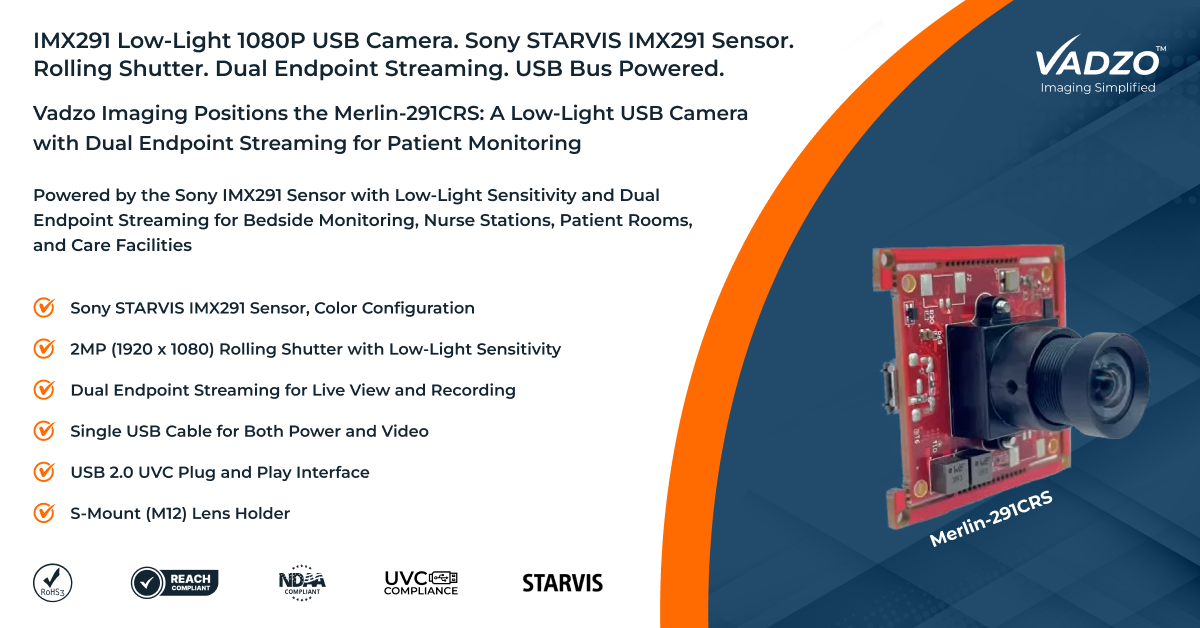
Product Overview
The Merlin-291CRS is an IMX291 Low-Light 1080P USB Camera built on the Sony IMX291 sensor and positioned specifically for patient monitoring deployments requiring both low light performance and flexible streaming. As an IMX291 2MP USB Camera, it is purpose-built for OEMs who need a single camera module to resolve usable video in a dimmed patient room while supporting both live nurse station viewing and local recording from the same hardware. The Sony IMX291 Medical USB Camera designation reflects Vadzo’s positioning of the IMX291 sensor’s low-light configuration specifically for healthcare bedside applications, where visible illumination is undesirable and dual-purpose streaming reduces installation complexity. The camera module houses the IMX291 sensor, ISP, and a USB 2.0 UVC controller with dual-endpoint streaming in a compact form factor with a standard S-Mount (M12) lens holder, functioning as a Bedside USB Sensitivity Camera suited to the working distances typical of a hospital bed and mounting point. As a 2MP Low-Light USB Camera, the camera enumerates as a standard UVC device on Windows, Linux, and Android, requiring no proprietary drivers for evaluation or production integration, and the 2MP IMX291 Low-Light USB Camera designation specifically confirms this low-light behavior in bedside conditions.
Key specs: 2MP (1920 x 1080) | Sony STARVIS IMX291 1/2.8 inch 2.9-micron pixel | Color | Rolling Shutter | Low Light Sensitivity | Dual Endpoint Streaming | USB 2.0 UVC | S-Mount (M12) Optics
Key Capabilities of the Sony IMX291 IMX291 Low-Light USB Camera
2MP 1080p Low-Light Resolution for Bedside Monitoring: Many patient monitoring camera products compromise on resolution or low-light performance to hold down cost, leaving clinical staff with a grainy or low-detail view exactly when a clear image matters most. The Merlin-291CRS, positioned as a 1080p Bedside USB Camera, captures full 2MP (1920 x 1080) video with usable detail well into dim room conditions, giving OEMs building a 2MP Bedside USB Sensor deployment a camera that holds image quality steady rather than degrading as the room lights are dimmed for the night. This makes it a genuine 1080p Clinical USB Camera suited to continuous observation rather than only well-lit daytime rounds.
Low Light Sensitivity for Overnight Patient Monitoring Without Disturbing Sleep: Patients recover better with uninterrupted rest, and a monitoring camera that requires bright visible light or a dedicated infrared illuminator to produce a usable image works against that goal by introducing a light source into the room specifically at the hours a patient is trying to sleep. The Merlin-291CRS, functioning as a 2MP Patient USB Sensor, resolves recognizable video at illumination levels well below what standard sensors require, letting a room stay dimmed for patient comfort while still producing video usable for observation. This benefits overnight monitoring programs where the alternative has historically been either an intrusive illuminator or an unusable image once the lights go down.
Dual Endpoint Streaming for Nurse Station and Documentation: Clinical monitoring workflows typically need two different things from the same camera at once: an immediate, low-latency view for a nurse glancing at a central station, and a higher quality recorded stream for later review if an incident needs documentation. The Merlin-291CRS, validated as a Low-Light Clinical USB Module, streams both from a single USB connection, so a facility does not need a second camera or a second cable run to get both capabilities. This makes the camera a practical foundation for nurse call and central monitoring systems where one feed serves real-time observation and the other serves the clinical record, without doubling the hardware at every bedside. A facility standardizing on this dual stream approach across an entire unit avoids the cost and cabling complexity of installing separate live view and recording camera units at every bed, since one camera and one cable now cover both requirements.
Compact USB Form Factor for Simple Bedside Integration: Patient rooms have limited space for additional equipment, and a bedside camera installation needs to add monitoring capability without adding meaningful bulk, wiring complexity, or maintenance burden to the room. The Merlin-291CRS ships as a USB Bedside Monitor Module in a compact housing that mounts easily to a bedside cart, wall bracket, or monitoring arm, functioning as a Compact Bedside USB Camera that fits the limited equipment space typical of a modern patient room, and behaves as a Low-Light Bedside Camera Kit that a clinical engineering team can deploy without extensive facilities work. Because the camera draws power over the same USB cable that carries its video, it also functions as a Cordless Bedside USB Module in the sense that no separate power supply or outlet is required at the mounting point, which matters in rooms where outlet access is already committed to medical equipment.
USB Plug and Play Integration Across Hospital IT Infrastructure: Hospital IT environments run a mix of desktop workstations, embedded terminals, and mobile carts, and a monitoring camera that requires a proprietary driver or a specific host platform complicates deployment across that variety. The Merlin-291CRS enumerates as a standard UVC class device, so it works immediately across Windows, Linux, and Android without a driver installation step, making it a dependable USB Care Facility Camera choice for facilities standardizing camera hardware across multiple room types and workstation configurations. This plug-and-play behavior shortens the deployment timeline for a facility rolling out monitoring capability across many rooms at once, since IT staff can connect and configure each unit without a platform-specific integration effort. Facilities that have standardized on different host platforms across different wings or building phases can deploy the same camera model everywhere, avoiding the parallel qualification effort a platform-specific camera would otherwise require for each environment.
OEM Integration for Patient Monitoring Programs: The Merlin-291CRS ships as a complete camera module rather than a bare sensor, giving patient monitoring OEMs a validated starting point instead of an open-ended integration project. For OEMs evaluating Vadzo as an OEM Bedside USB Module supplier, this means lens matching, firmware customization, and enclosure design support are available alongside the core camera hardware rather than as a separate engagement. As a Plug and Play USB 2.0 Camera, the Merlin-291CRS is validated across common desktop and embedded host platforms used in patient monitoring and care facility programs. Vadzo’s position as a Patient Monitoring USB Camera Supplier extends beyond the camera module itself to include volume production support, while its track record as a Sony STARVIS USB Camera Manufacturer covers programs spanning multiple sensor families and interface types for OEM customers building healthcare monitoring products.
“Clinical engineering teams building patient monitoring systems keep telling us the same thing: patients rest better in the dark, but staff still need a usable view overnight, and they need both a live feed for the nurse station and a recorded feed for documentation without doubling the hardware at every bed. The Merlin-291CRS was positioned to solve both needs together. By pairing the Sony IMX291’s low-light sensitivity with dual endpoint streaming, we give OEMs one camera that produces a usable image in a dimmed room and serves both the live monitoring feed and the recorded feed clinical teams depend on, from a single USB connection and a single cable at every bedside.” – Alwin Vincent, Product Manager, Vadzo Imaging.
Application Specific Sections
Bedside Patient Monitoring: Bedside monitoring systems need a camera positioned close to the patient that continues producing usable video as the room is dimmed for rest, without introducing a bright or obtrusive light source at the point of care. The Merlin-291CRS functions as a USB Bedside Monitoring Camera for these deployments, resolving recognizable detail in dim room conditions while its compact form factor mounts easily on the equipment already present at a typical hospital bed. As a Bedside Vitals USB Camera in this role, the camera supports the general observation tasks a bedside position covers, and its suitability as a USB Hospital Room Camera extends naturally to the broader hospital room environment beyond the immediate bedside.
Patient Room Video Monitoring: Patient room monitoring extends beyond the immediate bedside to cover the full room, supporting fall risk observation and general safety monitoring throughout a patient’s stay. The Merlin-291CRS serves as a Patient Room USB Camera for this broader coverage, combining low-light performance with a wide enough field of view from a single S-Mount lens position to support general room observation alongside close bedside monitoring.
Nurse Station Central Monitoring: Central monitoring stations depend on a reliable, low-latency video feed from every room under observation, often from many rooms displayed simultaneously on a single bank of monitors. The Merlin-291CRS operates as a USB Nurse Station Camera for this role, streaming a dedicated feed suited to continuous central viewing while a second stream from the same camera supports local recording, so a facility does not need to choose between live monitoring quality and archival documentation quality. Nursing staff monitoring several rooms from one station benefit from consistent image quality across every bed, since a single camera standard deployed facility-wide behaves identically regardless of which room a nurse is currently viewing.
Ward and Multi-Bed Monitoring: Multi-bed wards and step-down units need a monitoring camera standard that scales consistently across many rooms without introducing a different hardware configuration for each one. The Merlin-291CRS functions as a USB Ward Monitoring Camera for these deployments, giving facilities a single hardware platform to standardize on across a ward’s full complement of beds, simplifying both the initial installation and the ongoing maintenance and spare parts management across the unit. Biomedical engineering staff supporting a ward with dozens of beds benefit directly from this standardization, since a single spare unit and a single set of configuration procedures cover every camera on the unit rather than requiring separate spares and procedures for multiple camera variants.
Patient Safety and Fall Risk Monitoring: Fall risk monitoring depends on a camera that continues to produce a usable image throughout the night, since falls and other safety events do not confine themselves to well-lit daytime hours. The Merlin-291CRS serves as a Patient Safety USB Sensor for these programs, giving clinical teams a dependable overnight view that supports both real-time intervention and after-the-fact review of a safety event, without requiring the room to stay brightly lit against the patient’s comfort and rest. Facilities reviewing a fall or other incident after the fact benefit from having both a live alert capability and a recorded reference from the same camera, since the recorded stream preserves the exact conditions leading up to and following the event for later clinical and quality review.
Frequently Asked Questions
Q: Why does Vadzo Imaging recommend a low light camera for overnight patient monitoring?
A: Vadzo Imaging designs its patient monitoring camera lineup around a simple clinical reality: patients rest better with the lights dimmed, but care teams still need a usable view overnight. Vadzo Imaging validates low-light sensor performance specifically so that a monitoring camera produces recognizable video without requiring bright visible light or an intrusive supplemental illuminator at the bedside. Vadzo Imaging positions this capability as essential to overnight observation, not an optional upgrade over a standard daytime camera, and confirms this performance under actual dim room conditions rather than a controlled lab environment alone.
Q: Can Vadzo Imaging’s camera stream to a nurse station while also recording for documentation at the same time?
A: Yes. Vadzo Imaging’s patient monitoring camera lineup streams two independent video feeds from a single USB connection, one suited to continuous live viewing at a central monitoring station and another suited to higher quality local recording for later clinical review. Vadzo Imaging built this dual streaming capability specifically so that a facility does not need separate camera units or separate cable runs to get both a live view and a documented record from the same bedside position.
Q: Is Vadzo Imaging’s patient monitoring camera easy to install in an existing hospital room?
A: Yes. Vadzo Imaging’s camera connects over a single USB cable that carries both power and video, so a bedside installation does not require a separate power supply or dedicated outlet at the mounting point. Vadzo Imaging designs this simplicity deliberately, since a facility deploying monitoring capability across many rooms benefits from a camera that adds minimal wiring and mounting complexity to each installation.
Q: Does Vadzo Imaging’s camera work with common patient monitoring and telehealth software platforms?
A: Yes. Vadzo Imaging’s camera enumerates as a standard UVC class device, so it works immediately with the wide range of monitoring, telehealth, and video management software already common across healthcare IT environments without a proprietary driver or a platform-specific integration step. Vadzo Imaging prioritizes this compatibility so that a facility can pair the camera with the monitoring software it has already selected rather than being locked into a single vendor’s software stack, which matters for facilities that have already invested in a particular monitoring platform across other departments.
Q: Why should healthcare facilities choose Vadzo Imaging as their patient monitoring camera supplier?
A: Vadzo Imaging offers more than a camera module built around a capable sensor. Healthcare facilities and OEMs working with Vadzo Imaging receive engineering support covering lens selection, firmware customization, and enclosure design guidance alongside the core camera hardware. Vadzo Imaging maintains evaluation kits with no minimum order requirement, so clinical engineering teams can confirm low-light performance and streaming behavior on their own deployment before committing to volume production. This combination of validated hardware, dual stream flexibility, and low minimum evaluation access is why healthcare facilities continue to choose Vadzo Imaging for patient monitoring camera programs.
Availability
The Merlin-291CRS IMX291 Low-Light 1080P USB Camera built on the Sony IMX291 sensor is available now for evaluation and production orders. Evaluation kits include the camera module, S-Mount lens, USB 2.0 cable, and platform driver documentation, with no minimum order requirement. Clinical engineering teams can confirm low-light performance and dual-stream behavior directly in a representative patient room before committing to a facility-wide rollout, which matters more for this camera than a datasheet comparison alone could confirm. Browse the full USB 2.0 Bedside Camera Kit lineup at Vadzo’s website or contact Vadzo at support@vadzoimaging.com to request an evaluation unit or discuss OEM integration requirements for patient monitoring, nurse call, and care facility camera programs.
About Vadzo Imaging
Vadzo Imaging is a global provider of embedded vision solutions and delivers high-performance camera technologies and imaging platforms for applications in robotics, industrial automation, UAVs, edge AI, and medical systems. Its products are designed for seamless integration with leading embedded platforms. Vadzo supports customers through hardware customization, firmware development, and module-level drivers, enabling faster development and deployment of vision-based systems across USB, MIPI, GigE, Wi-Fi, and SerDes camera interfaces.
Media Contact
Alwin Vincent
Vadzo Imaging
Email: alwin@vadzoimaging.com
LinkedIn: Vadzo Imaging
YouTube: Vadzo Imaging
X: Vadzo Imaging
SOURCE: Vadzo Imaging
View the original press release on ACCESS Newswire
Media gallery