
WATERBURY, CT, Sept. 17, 2026 (GLOBE NEWSWIRE) — Maganti IT Resources, LLC, a global provider of software engineering and cloud solutions, highlights a critical shift in maritime digital transformation: moving beyond data collection toward connected systems and trusted operational intelligence. Drawing industry research, emerging regulatory developments, and practical implementation experience, the company examines how fleet operators can address fragmented information, strengthen operational visibility, and improve regulatory readiness. With the global maritime digitization market projected to reach $229.7 billion in 2026, the analysis emphasizes the growing importance of interoperability, data governance, and reliable information exchange between vessel and shore-based systems. The central message is clear: the next phase of maritime digitalization is not simply about generating more data, but ensuring that existing information is connected, verified, and accessible when critical decisions must be made.
The industry now holds more fleet data than at any previous point: sensor readings, maintenance records, inspection findings, voyage data, crewing information, compliance documents, and commercial data. The organizations that can turn that information into a trusted answer quickly, and for the person who needs it, will gain an advantage over those that still treat data collection as the endpoint.
For technical and compliance leaders, the implication is direct. The next step is not simply collecting more data. It is building the capability to find, validate, and act on the information the organization already holds before the opportunity to act has passed.
Defining the Terms and the Stakes
Digitization means converting records and activity into digital form. Digitalization means using that digital capability to change how the work itself is done. That distinction sits at the center of the argument that follows.
Sizing the Opportunity
The investment behind the first phase is substantial. Persistence Market Research projects that the global maritime digitization market will grow from $229.7 billion in 2026 to $453.1 billion by 2033, a compound annual growth rate of 10.2 percent (Persistence Market Research, 2026). That analysis identifies hardware, including IoT enabled sensors, smart navigation systems, and automation equipment, as the largest single component in 2026, while software and analytics are expected to grow faster.
That growth reflects a sector pursuing more visibility, automation, efficiency, and regulatory readiness. Yet data volume alone does not create operational value. The harder challenge is ensuring that data can move between systems, retain its context, and be trusted when a decision must be made.
Where Capital Is Flowing
The Technology Buildout
Fleet operators are adopting IoT enabled monitoring, predictive maintenance tools, digital twin capabilities, voyage optimization, and digital compliance platforms. These technologies can improve reliability, reduce manual effort, and support better operational decisions.
At the same time, maritime organizations often run a landscape of specialized systems: inspection and audit tools, planned maintenance platforms, crewing applications, procurement systems, finance tools, vessel performance platforms, and document repositories. Each may perform its intended function effectively. The problem arises when they cannot readily exchange information, or when the data they hold cannot be reconciled into a current and authoritative operational picture.
The Regulatory Tailwind
The policy direction is moving the same way. Meeting in London for its fiftieth session from 23 to 27 March 2026, the IMO Facilitation Committee approved the IMO Strategy on Maritime Digitalization and agreed to forward it to the Maritime Safety, Legal, and Marine Environment Committees for review before submission to the IMO Assembly in 2027 (International Maritime Organization, 2026a). The strategy establishes digitalization as an overarching IMO policy and emphasizes interoperability, system standardization, data sharing, and effective data governance across organizations and jurisdictions.
An action plan supporting implementation is being prepared by a correspondence group for consideration at the Committee’s next session (International Maritime Organization, 2026b). Earlier work at the forty ninth session, which approved a new version of the IMO Compendium on Facilitation and Electronic Business, addressed consistent data formats and interoperability across shipboard and shore IT systems (International Maritime Organization, 2025).
The direction is therefore settled. Maritime digitalization is increasingly about connected, standardized, secure information flows, not merely adding another source of data.
The Cost of Inaction
Operational Risk: When Fragmentation Becomes Exposure
Consider a finding raised during an onboard inspection. The crew may close the finding and upload supporting evidence in one system. But if that resolution is not visible to the compliance team, to fleet management, or to a team preparing for an external inspection, the organization can still appear exposed.
The issue is not necessarily that the information is missing. It is that the information is isolated. This creates avoidable work and avoidable risk:
- Shore teams spend time chasing updates across systems, emails, and spreadsheets.
- Evidence must be manually reassembled before audits, inspections, or vetting reviews.
- Leaders make decisions using incomplete or outdated information.
- The organization cannot easily demonstrate that a finding has been properly resolved and verified.
The consequences are material: Port State Control detentions, adverse vetting outcomes, audit findings, delayed voyages, off hire exposure, and reputational damage. The cost is not limited to the original defect. It includes the time and friction created when the organization cannot quickly establish what happened, what was done, and whether the result is reliable.
Commercial Risk: The Price of Slow Answers
Charterers, insurers, regulators, and customers are placing more weight on timely operational and compliance visibility. Real time monitoring and reporting now sit close to the center of the business case for maritime digitalization, particularly where operators must demonstrate operational control, risk management, and compliance readiness (Ideagen, 2025).
In practice, many fleets still need hours, and sometimes the better part of a working day, to produce a current fleet wide status update. This reflects observed operational practice rather than a measured industry benchmark, but the cause is consistent: the underlying information exists, yet no single view brings it together reliably.
That delay matters. A status report assembled manually is already aging while it is being prepared. By the time it reaches a Designated Person Ashore (DPA), a vetting desk, a chartering team, or an executive, it may no longer represent the fleet’s actual position.
The pattern is not unique to any one organization. One of the world’s largest ship and corporate registries, faced a similar version of the same problem: support requests scattered across departments, each with its own process, with no shared view of case status. Unifying that workload onto a single case management platform cut resolution times by 60 percent and licensing costs by 40 percent, while giving every team the same real time view of an issue’s status (Maganti IT, 2026). The gain came from connecting existing workflows, not from adding a new source of data.
Across a fleet, these issues become the compounding cost of collecting data without creating a trusted way to use it.
A Maturity Model for Maritime Data: Capture, Connect, Confidence
Many maritime technology discussions focus on a single question: how much of the operation has been digitized? That framing can be misleading, because it treats digitization as the finish line. A more useful approach separates the challenge into three practical layers.
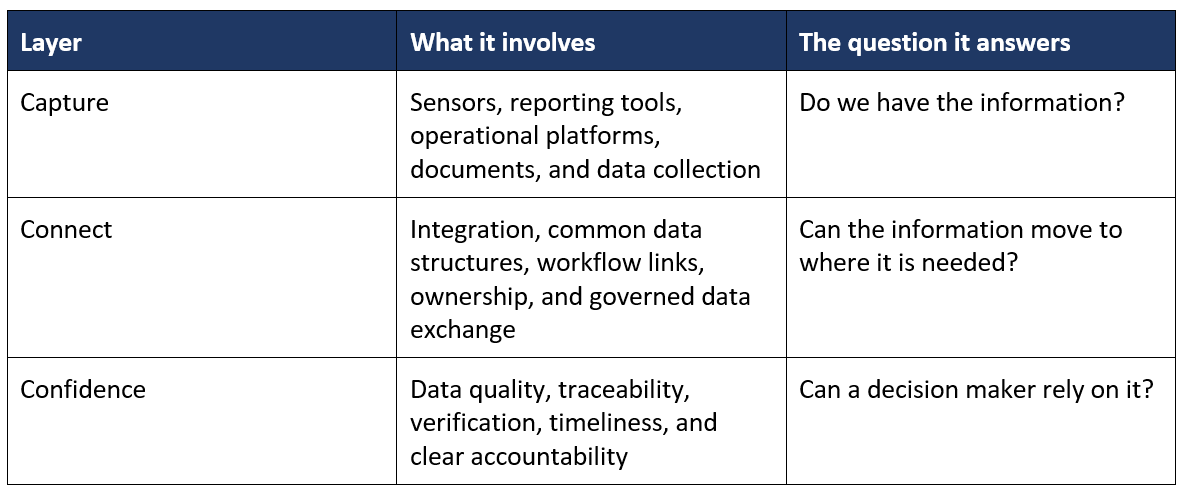
Table 1. Three layers of maritime data capability.
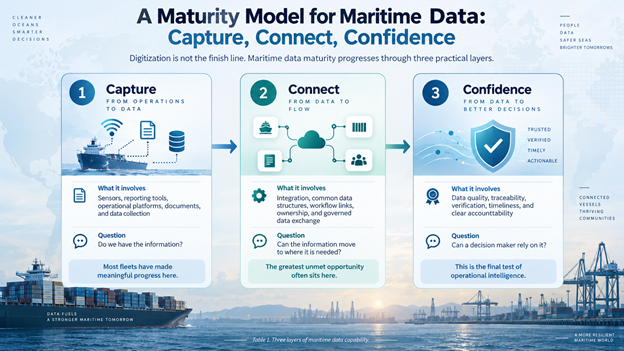
Most fleets have made meaningful progress on Capture. They have systems that generate data across maintenance, safety, operations, compliance, and commercial activity.
The greatest unmet opportunity often sits in Connect. An inspection platform may not share its closed-out findings with compliance reporting. A maintenance system may not give finance a timely and usable view of cost, criticality, or downtime exposure. Vessel performance data may be available but not connected to the operational or commercial decisions it is meant to inform.
Confidence is the final test. A DPA, a vetting team, a superintendent, or a charterer should be able to see not only the status, but also its source, owner, timestamp, supporting evidence, and any unresolved exception. Without that, organizations have data, but not dependable operational intelligence.
From Framework to Execution
Building connectivity does not necessarily mean replacing every existing platform. In many cases, fleets already have systems that work well within their own domains. The higher value intervention is often to connect priority workflows across those systems. That can include:
- Linking inspection findings to corrective action workflows, supporting evidence, and compliance reporting.
- Connecting planned maintenance data to procurement, finance, and operational risk views.
- Bringing vessel, shore, and third-party data into a governed operational view rather than relying on manual reconciliation.
- Establishing common identifiers, data definitions, ownership rules, and approval processes, so that one status does not mean different things in different systems.
- Creating role specific dashboards and alerts that surface exceptions rather than forcing people to search through raw records.
The goal is not a single monolithic platform. It is a trusted operating layer that lets existing systems share the information they already hold, turning status updates from a one-off scramble into predictable delivery, the same information available on the same terms whenever it is needed.
That same distinction matters for artificial intelligence. Predictive maintenance, digital twins, and AI assisted decision support can create real value, but only when the underlying data is complete, current, traceable, and governed. AI cannot resolve inconsistent records or disconnected workflows on its own. it will only produce faster output from unreliable inputs.
A Decision Framework for the Next Investment
Before approving another technology investment, technical and compliance leaders should ask:
- Which workflow creates the greatest current exposure? Identify the point where delays, manual reconciliation, uncertainty, or duplicated work create the greatest operational, compliance, or commercial risk.
- Can the right stakeholder obtain a current, trusted status when needed? A DPA, a vetting desk, a superintendent, or a chartering team should not need to assemble a critical status update from multiple systems and email threads.
- Is the problem capability or connectivity? Determine whether the organization truly lacks a system, or whether existing systems need to exchange data, align definitions, and feed a more usable workflow.
The Strategic Imperative
In many cases, the answer will be connection rather than replacement. Maritime has made substantial progress in stocking the shelves. The next opportunity is to build the catalogue: the trusted operating layer that lets people find, understand, and act on the information they already have, now it matters.
About the Company
At Maganti IT Resources LLC (Maganti IT), we help organizations transform ideas into reliable technology solutions through engineering expertise, innovation, and strategic execution. We specialize in software development, cloud solutions, AI-driven technologies, application modernization, DevOps, data engineering, and quality engineering services.
Our experienced teams work alongside businesses to solve complex technology challenges, improve operational efficiency, and build scalable digital solutions that support long-term growth. With a focus on quality, collaboration, and predictable delivery, we help organizations navigate digital transformation with confidence.
Maganti IT Resources, LLC is committed to becoming a trusted technology partner by delivering solutions that align with business goals and create measurable impact.
Sruthi Kondiparthiss | Content Specialist
Sources
Ideagen. (2025). Maritime digital transformation trends for 2026 and real time monitoring ROI. https://www.ideagen.com/thought-leadership/blog/maritime-digital-transformation-trends-for-2026-and-real-time-monitoring-roi
International Maritime Organization. (2025). Facilitation Committee (FAL), 49th session, 10 to 14 March 2025. https://www.imo.org/en/mediacentre/meetingsummaries/pages/fal-49th-session.aspx
International Maritime Organization. (2026a). Facilitation Committee approves digitalization strategy and cyber security measures. https://www.imo.org/en/mediacentre/pressbriefings/pages/facilitation-committee-approves-digitalization-strategy-cyber-security-measures.aspx
International Maritime Organization. (2026b). Facilitation Committee (FAL), 50th session, 23 to 27 March 2026. https://www.imo.org/en/mediacentre/meetingsummaries/pages/fal-50th-session.aspx
Persistence Market Research. (2026). Maritime digitization market forecast 2026 to 2033. https://www.persistencemarketresearch.com/market-research/maritime-digitization-market.asp

Name: Prasad Maganti
Email: magantilp@mitresource.com
Job Title: Founder and CEO


