
Ozark, MO – September 02, 2026 – PRESSADVANTAGE –
Mr. Dent Collision Repair has published a new consumer guide explaining collision repair supplements and why information in a repair plan can change after work begins.
The September resource expands the company’s collision repair information with a focused explanation of what happens between an initial vehicle evaluation and a more detailed repair plan. It addresses a common source of confusion for vehicle owners: an initial estimate can reflect the conditions accessible at the beginning of the process, while additional collision-related information may become available when damaged components are removed or previously covered areas become accessible.
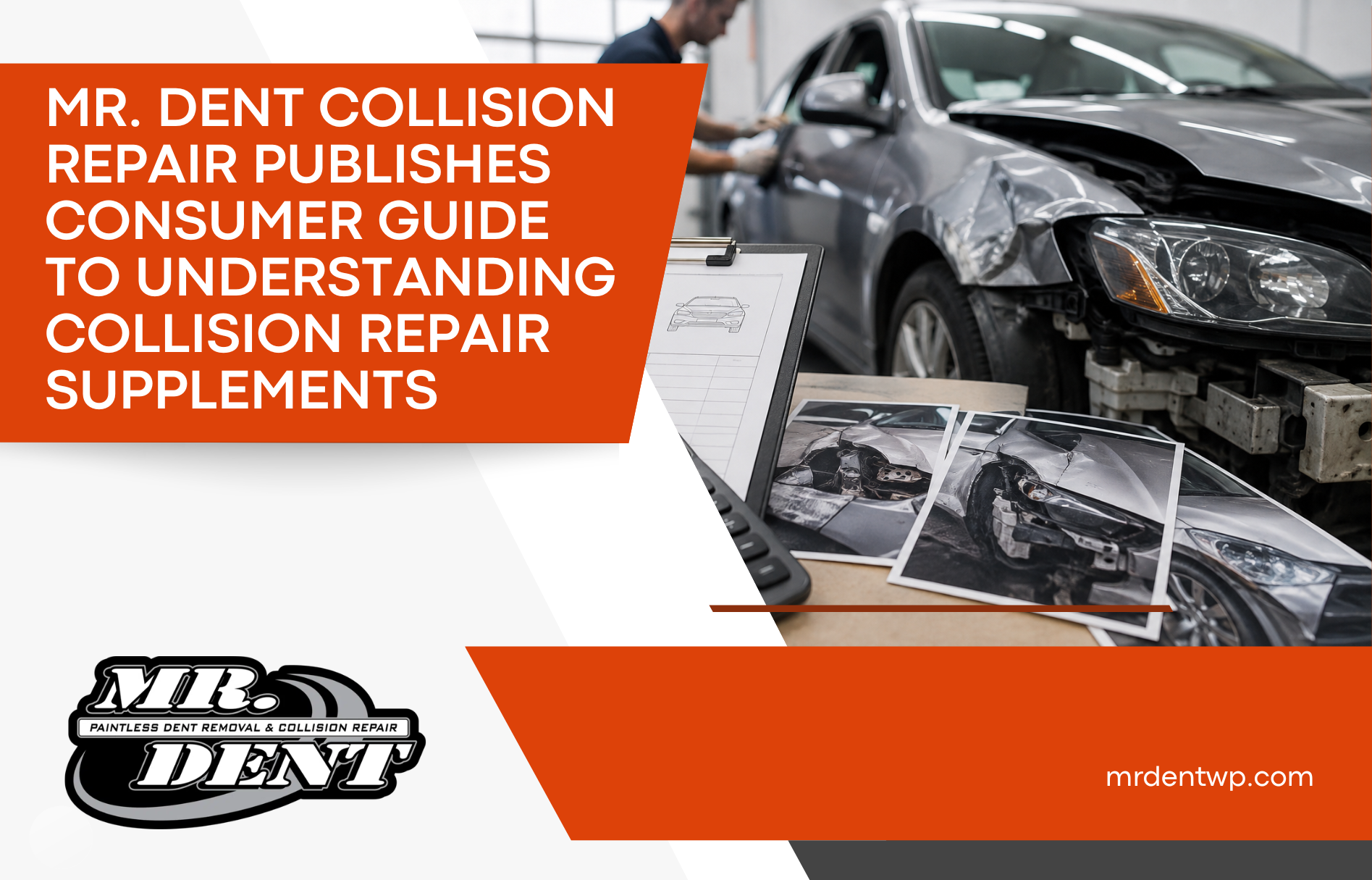
Mr. Dent Collision Repair developed the guide for consumers served by its Ozark facility at 2116 N 20th St, Ozark, MO 65721. The new material organizes the subject around four stages: initial damage documentation, vehicle-specific repair research, access gained during disassembly, and documentation of additional findings through a supplement.
The first stage covers information available during the initial evaluation. Technicians can document visible conditions involving bumpers, fenders, doors, hoods, lamps, quarter panels, liftgates, and other affected exterior components. Photographs, vehicle information, and observations about the location and characteristics of the damage can contribute to the initial repair information.
That initial documentation represents conditions that can reasonably be identified at that stage. It does not necessarily represent every operation or component that ultimately becomes part of a completed repair plan.
The second stage addressed by the guide involves vehicle-specific repair research. Year, make, model, equipment, component construction, and the areas affected by a collision can influence which repair procedures are relevant. Modern vehicles can incorporate different grades of steel, aluminum, plastics, composites, electronics, and other materials within exterior and structural assemblies.
Manufacturer repair information can therefore become an important part of determining how an affected component is addressed. Depending on the vehicle and repair, applicable information may cover component removal and installation, joining methods, material-specific procedures, inspection requirements, or other operations associated with the affected area.
The new guide then explains why disassembly can provide information that was not accessible during the initial exterior evaluation.
A bumper cover, exterior panel, lamp assembly, trim component, or another damaged part can limit access to mounting points, brackets, fasteners, reinforcements, absorbers, and adjacent components. Removing components as part of repair planning can allow technicians to inspect areas that could not previously be viewed in sufficient detail.
The guide emphasizes that this does not mean every collision contains concealed damage or that every initial estimate will change. Additional conditions become part of the repair plan when they are actually identified and documented for the individual vehicle.
When collision-related findings become available after the initial estimate, a supplement can be used to record the additional information. Depending on the circumstances, a supplement may document additional repair operations, parts, materials, procedures, or other items associated with the updated repair scope.
Mr. Dent Collision Repair’s September publication specifically adds this explanation because the term “supplement” can be unfamiliar to consumers encountering the collision repair process for the first time. The guide distinguishes a supplement from an assumption that an original estimate was incorrect. Instead, the documents can represent different stages of information availability during repair planning.
For example, exterior damage may initially identify a bumper as an affected area. Access obtained after removal can provide additional information about the condition of mounting hardware or components located behind it. Any documented findings can then be considered along with applicable vehicle-specific repair information when the repair plan is updated.
The same principle can apply to other collision-affected areas where one component limits access to another. The determining factor is the condition documented on the particular vehicle rather than a general assumption based on the appearance or severity of the collision.
The guide also addresses the distinction between additional findings and additional damage occurring during the repair process. A supplement can document collision-related conditions that became accessible later; its existence alone does not establish when a condition occurred or why a particular operation is required. Those conclusions depend on the documented vehicle condition and applicable repair information.
For consumers, the four-stage framework provides a more straightforward way to follow the progression of collision repair documentation. An initial evaluation records accessible conditions. Vehicle information supports repair research. Disassembly can provide access to additional areas. Documented findings can then be incorporated into an updated repair plan when applicable.
This progression can also help explain why two vehicles with superficially similar exterior damage may not ultimately have identical repair plans. Differences in vehicle construction, equipment, affected components, access, and documented conditions can produce different repair considerations.
The September guide does not characterize supplements as unusual or inevitable. Instead, it explains their function within repair documentation and gives vehicle owners context for understanding why information available later in the process can differ from information available during the first evaluation.
The publication also gives consumers a practical reference for conversations about changes to repair documentation. When a supplement is prepared, vehicle owners can review which additional conditions were documented, what changes were made to the repair plan, and how those changes relate to areas that became accessible during the process.
By concentrating specifically on supplements, the new resource adds a subject not previously addressed in detail within Mr. Dent Collision Repair’s broader consumer information. It is intended to make repair documentation terminology easier to understand without prescribing a particular repair method or suggesting that every collision follows an identical sequence.
The new consumer information is available through Mr. Dent Collision Repair’s collision repair resource. Additional information about auto body repair and the company’s OEM-certified repair capabilities is available through its website.
Consumers can also find information about Mr. Dent Collision Repair’s Ozark facility through the company’s location information or contact the facility through its contact page.
About Mr. Dent Collision Repair
Mr. Dent Collision Repair serves vehicle owners in Ozark, Missouri, and surrounding communities from its facility at 2116 N 20th St, Ozark, MO 65721. The company provides collision repair, auto body repair, paintless dent repair, auto glass repair, OEM-certified repair services, and related vehicle restoration services. Additional information about the company and its history is available through the Mr. Dent Collision Repair About page.
###
For more information about Mr. Dent Collision Repair, contact the company here:
Mr. Dent Collision Repair
Logan Martin
417-581-5103
logan@mrdentmo.com
2116 N 20th St, Ozark, MO 65721, United States


